
History of Encaustic Cement Tile
Even though "mosaicos hidrálico" as they are known in many places and are still used extensively all over the world, in the United States they are relatively unknown. Even the recent comprehensive books on tile totally ignore this entire category. The only decor books that seem to acknowledge encaustic cement tiles are pictorial books about Havana, Cuba, other Latin countries, and the architecture of Europe.
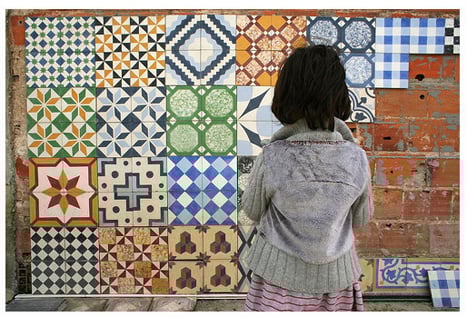
Cement tile is extremely durable
India has a region that is famous for this type of floor tile. Since the manufacturing of the encaustic cement tile does not require fueled heat, as the firing of a ceramic or porcelain tile does, it is possible for tile-making to be located in remote and rustic areas. Occasionally you see the tiles referred to as "rusticos". In Miami and South Florida our tiles are called "Cuban tile". And in Cuba known as Cuban mortar tiles, "losa hidráulica", or "losatea hidráulicos" (hydraulic slab). The first cement tiles in Cuba were imported from Spain. Cuba may have been the second coutry in Latin America to start making mosaicos hidraulicos following Mexico. The first documented Cuban tile factory was in 1886. When it was founded in 1903, the La Cubana factory was the largest in the world. It also produced some of the best tile at the time. Aside from the obvious advantages, they also used mined sand (lower in salt content that can discolor the tile), and had numerous artisans who had worked for popular Barcelona factories.
In Italy this type of tile seems to be referred to as "pavimenti in graniglia" even though the term also applies to terrazzo floors. Also in Italy I see encaustic cement tile called "cementine" although the word in not in broad usage, as well as "pastina" or "pasta tiles". To the Manilans this type of tile is known as "malaga", and in France and Belgium is a direct translation to cement tile, either "carrelages du ciment" or "carreaux du ciment".
Until the 1920's, colorful cement tiles were considered high-end ultimate flooring that decorated the palaces of the Tsars, the mansions of the Côte d'Azure, Gaudi's Barcelona and Berlin's official buildings. Later on, the encaustic cement tile expanded as a creative and durable flooring all over Europe, and the former colonies of France, Spain and Portugal. Around the 1950's, cement tile lost importance and was replaced by less expensive and less colorful floors. At the beginning of this century, the trend for authentic products and 'green' flooring has brought attention back to encaustic cement tiles. Recent storms along the Gulf Coast have raised awareness of durable, waterproof architecture. We hope to spread the word. We have first-hand knowledge of the need for sensible flooring in coastal Alabama. Additionally, this type of tile flooring is perfect for high traffic areas and any place where discriminating people gather.
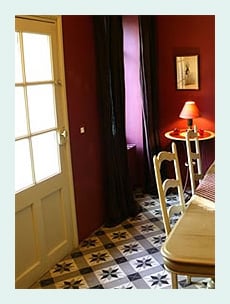
No matter classical pattern or modern design, we can customize your tile
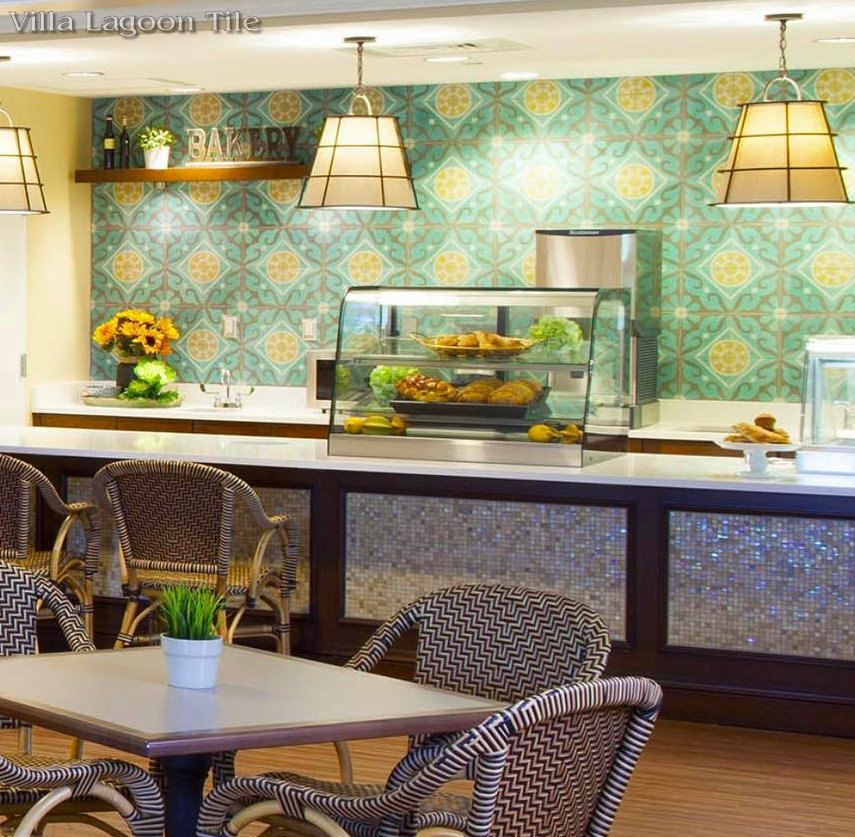
Not only used for floor, cement tile is also nowadays using more in wall decoration
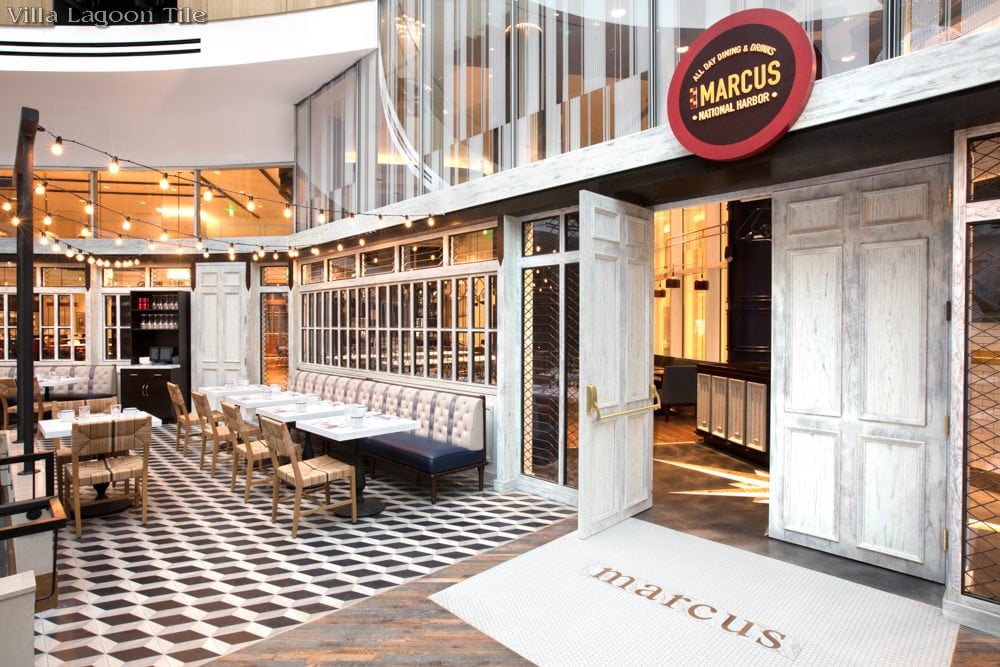
Pattern: Large Cube Design
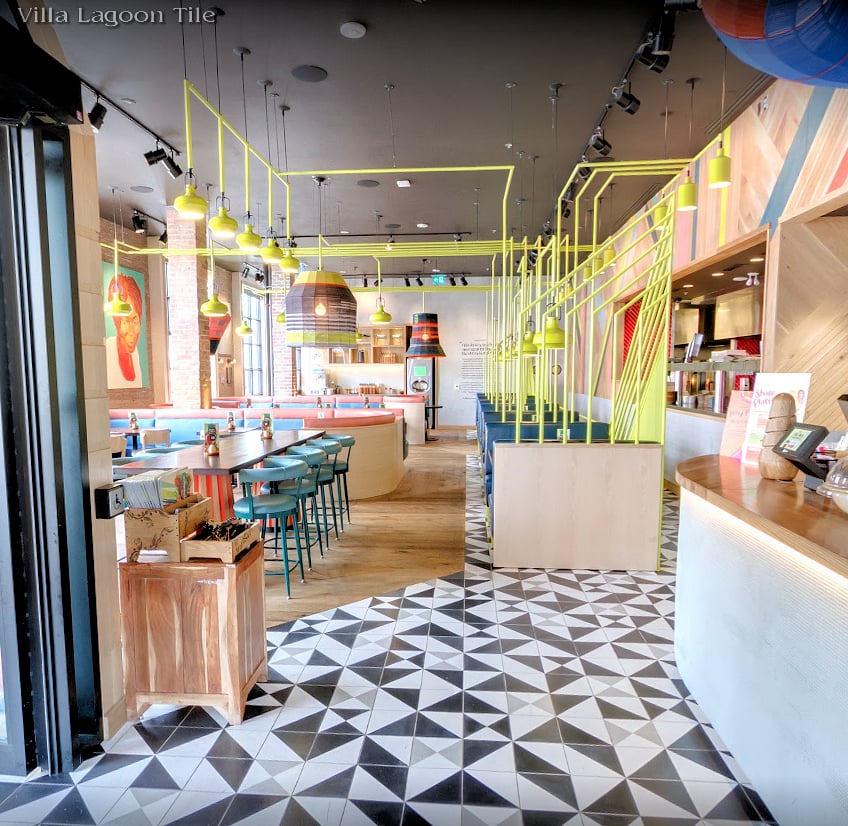
Pattern: Man Overboard Black & White
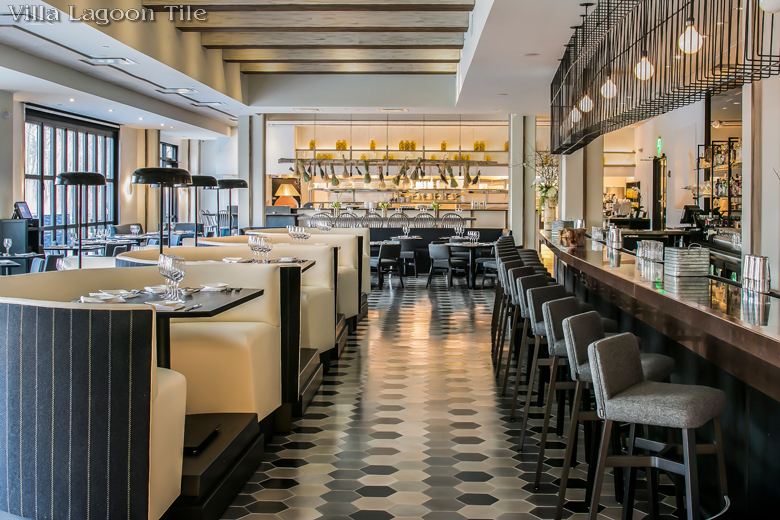
Pattern: Mixed Gray Hexagon
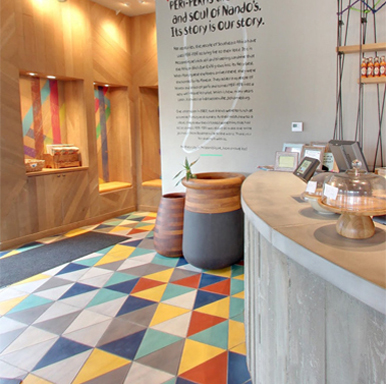
Pattern: Custom Troika
It has never been possible to create an industrialized product that can substitute for this handmade tile. The variety of colors, the matte finish (though they can be polished and waxed), and the soft silky texture are characteristics that make this tile absolutely unique. It is very important to note that no two tiles are exactly alike.
Encaustic cement is flooring with character, of great quality, outstanding for its clear, bright finishes, excellent ageing process, elegance and nobility.
Check these antique tiles posted on Imelda's Design Blog, from her trip to Central Java. According to the home owner, the tiles were already there when her father was born in 1922. She was told that the tiles have been there since the late 1800's. Look at the sheen and the brilliant colors.
See the "Mosaicos de Pasta" (Paste Tiles), or "ladrillos", of this small hotel in Merida, Yucatán, Mexico: Casa Mexilio. Merida is one of those places where these tiles took off. According to the writer of their blog, almost every home in Merida built before 1950 has cement tile. According to a local design firm, cement tiles were originally brought to Yucatán as ship ballasts. Because the components of cement were plentiful in Yucatán, and fine clays were rare, cement tile became the ornamentation of choice for all important buildings. The region's first factory was opened at the start of the 20th century by Rafael Quintero, and Materiales Traqui continues to operate just outside Merida in Ucú.
A very nice French web page gives (in English) the history of the kiln-fired ceramic encaustic tile as well as info on carreaux de ciments tiles, the cement encaustic tiles, similar to our tiles. The Antique Floor Company.
Some Background on
Encaustic Tiles
The best discussion of what "Encaustic" tiles are and how they have been made over time was on the Stoke-on-Trent Museum website. Although removed, you can still find a cached copy here at the Internet Archive. The article is about ceramic tile (unlike our cement tile) but tells about the term "encaustic" which has a lot of confusion associated with it. I am including it here as many people reach this page whilst doing research on encaustic tiles.
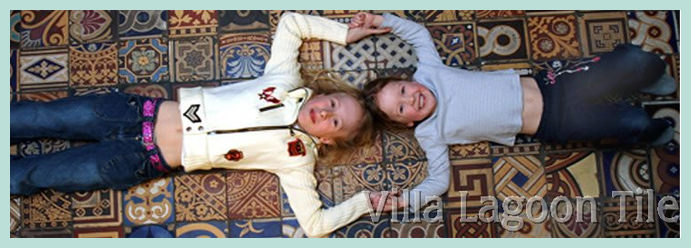
Encaustic: A clay pattern was embedded into the body of the tile, the two sections fusing during firing.
...
Medieval tile making
Tile making was associated with monasteries and palaces, the large buildings of their time. Potters travelled around the country using local clays and firing them on site. The tiles were hand made, by flattening the clay and cutting pieces into shape. The only mechanical aid was a wooden mould carved in relief, which indented a pattern on the clay slab. The slab would be dried and the impression filed with white pipe clay. After further drying this would be shaved flat.
A glaze of lead ore was sprinkled onto the surface and the tiles were then fired. These 'encaustic' or inlaid tiles were made from the 12th to 16th centuries. This skill disppeared with the dissolution of the monasteries, and was not revived until the mid-19th century.
Making encaustic tiles - dust clay
In 1863 William Boulton patented a method of making encaustic tiles using dust clay. The patterned part of the tile was formed using one or more copper plates which were perforated to the required design. Guide pegs located the plate on the bed of the press and the hollows in the mould were filled with dust clay.
A die whose relief pattern corresponded to that of the plate was used to compress the clay, a ram coming down in such a way that the plate was removed as it returned. The frame was filled with more clay of a different colour that would form the body. As this was compacted, the inlaid section was bedded into the face of the tile. This method increase speed of production and so a cheaper tile was available to a wider market. The dust pressed process never ousted the plastic clay method, and the two ran side by side.
Encaustic tile revival
Archaeological excavations of medieval sites aroused much interest in encaustic tile making. Herbert Minton began experimenting in 1828, and in 1830 bought a half share in Samuel Wright's patent for the production of encaustic tiles. It was several more years before their results were reliable, and a catalogue was issued in 1835 containing designs based on medieval originals.
Very soon he was receiving commissions from churches to lay encaustic tile pavements, and success was guaranteed when he found the patronage of Queen Victoria and Prince Albert making a pavement for Osbourne House. The fashion for encaustic tiles spread with the Gothic Revival lead by Augustus Pugin who was a friend of Herbert Minton.
Encaustic tile making was the greatest stimulus to the development of the Staffordshire tile making industry in the nineteenth century. The district was a natural centre as clay and coal were available, and a skilled workforce to call on because of the established pottery industry.
Making encaustic tiles - plastic clay
The mixture for the tile body might contain red clay or ball clay, china clay and flint. Chemicals were added to produce the different colours. Water was added to form a slip (liquid clay) which was sieved. The clay was dried on plaster bats, which absorbed the water to bring it to a plastic state.
A pug mill then tempered the clay (formed a compact mass with no air bubbles.) The tile was formed in a metal frame, the relief pattern that formed the indentation in the bottom. The clay was added in a sandwich fashion: firstly a quarter inch of fine clay; a thick coarse clay layer; then a quarter inch of fine clay. This method prevented warping, and gave a fine clay surface while the body was robust. A plate was placed over the frame and the layers pressed together.
The tile was allowed to dry, then slip was poured onto the surface filling the indented pattern. After three days, drying the surface was scraped to reveal the design and after further drying they were fired. This process was manual except for the few machines that prepared the clay.
Making wall tiles
...
In 1840 Richard Prosser patented a process for making clay buttons from dust clay. Herbert Minton was quick to realise that this process could be converted to make ceramic tiles, and he bought a share in the patent. The wall tiles were different from the encaustic in that they were lighter and had a larger proportion of calcined flint to produce a white body and usually a surface glaze decoration. The clay was cleaned and dried in heated troughs.
It was important to get the right water content, as the clay felt dry - hence 'dust clay'. After leaving the drying beds, the clay was ground to a fine dust that had natural cohesion when under pressure, and could be handled without further drying. If a tile had a surface pattern a die was placed into the tile press. The presser wiped the plates of his press with a greasy rag, filled the mould with dust clay and scraped the surface level. He lowered the press by turning a large horizontal wheel at the top, this exerted enormous pressure on the face of the tile and thus compacted it. The tile was forced out of the press by a foot pedal. This method changed little throughout the 19th century except for the invention of the steam driven press first used by Maws in 1873.
...
...
New Uses for Old Tiles
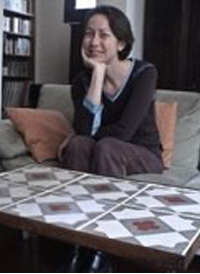
Benedicte Bodard collects hydraulic tiles from dumpsters of apts being remodeled. She gives them a new life, a second chance as elegant table tops. See them at her blog: mesabonita.blogspot.com
Worldwide Encaustic Tile Information
Tessellation Defined
A large collection of photos of concrete tile floors, see as a cement tile floor slideshow.
A discussion & photos: http://www.flickr.com/groups/mosaico_hidraulico/discuss/72157603679516312/
Photos on Flicker http://www.flickr.com/photos/rosapo-mar/sets/72157603593890933/

A good article on Miamism Blog about Cuban Tile
Baldozas y Azulejos de Cemento
You will find people using many terms to refer to cement tiles and the art:
Mosaicos, ladrilhos, carreaux, Fliesen, fliser, baldosas, mosaico hidráulico, encaustic tiles, Victorian Tiles, klinker, mosaik, mosaic, Plavuizen,Fliser, klinker, ladrilhos, Zementfliesen, revestimentos, gulvbeklædning, azulejos, Wandfliesen, Bodenfliesen, carrelages, carreaux ciment, ladrilhos de pasta, Fliesen, cast tiles, Victorian tiles, baldosa artesanal, baldosas hidráulicos, plavuizen, gegoten plavuizen, wandtegels, mattonelle, piastrelle, pavimentos, suelos, vægbeklædning, gulve, Bodenbekleitung, Wandbekleitung, cozinha, banho, bagno, køkken, cucina, cuisine, arquitectura, building materials, Baumaterialen, bygningsmaterialer, materiais de construção, restauro, indretning, decoração, decoracion, projecto, fliser, plavuizen, lda, hidráulico, klinker, mosaicos, baldosas, pavimentos, revestimentos, fabrica, cores, para and zement.
Our Czech clients have referred to our tiles as "betonová dlažba" or "betonové dlaždice na podlahu", and our Argentine friends call them "mosaicos calcáreos".
We are finding that people allover the globe are finding our website and learning about the classic art of cement tiles. This has been so exciting to us to reach out to people everywhere that are so excited to discover that this wonderful flooring is still available.